Our supply chain
Our suppliers
The sustainability of our supply chain is a core focus in our commitment to responsible business practices. We believe in creating a transparent, ethical, and environmentally conscious supply chain. This involves partnering with suppliers who share our values, uphold fair labor practices, minimize their environmental impact, and prioritize sustainable sourcing.
We are dedicated to reducing carbon emissions, promoting ethical sourcing, and ensuring the well-being of workers throughout our supply chain. By fostering sustainability at every step, we aim to create a resilient and ethical supply chain that delivers value while preserving the planet and benefiting all stakeholders involved.
| Corporate Sustainability Policies / Politicile Corporative de Sustenabilitate / Корпоративные Политика Устойчивости / Politike Korporativne Održivosti | EN | RO | RU | RS |
| Corporate Sustainable Sourcing Policy | 📜 | 📜 | 📜 | 📜 |
| Deforestation-Free Supply Chain Policy | 📜 | 📜 | 📜 | 📜 |
| Corporate Responsible Crop Protection Products and Fertiliser Usage Policy | 📜 | 📜 | 📜 | 📜 |
| Corporate Responsible Agricultural Commodities Supply Policy | 📜 | 📜 | 📜 | 📜 |
| Corporate Diversity and Inclusion Policy | 📜 | 📜 | 📜 | 📜 |

Corporate Sustainability Development Strategy (2025–2030) Targets:
- We target 80% of commodity suppliers to accept and sign our Supplier Code of Conduct with ESG principles by the end of 2027, vs. 2022-2023 baseline.
- We target 80% of new suppliers to provide/fill-in ESG self-assessment by the end of 2027, vs. 2022-2023 baseline.
- We target 500 farmers to be trained on conservation and regenerative agriculture by the end of 2028, vs. 2022-2023 baseline.
- We will facilitate 500 extensive soil sampling and analysis on farmland by the end of 2028, vs. 2022-2023 baseline.
- We target 500 primary suppliers of key commodities to be audited on ESG principles and criteria at least once by the end of 2030 (2025 performance: 0).
- We target 20% of key agricultural commodities to be sourced in line with sustainable agricultural principles¹ by the end of 2030 (2025 performance: 0.5%).
- We target 80% of crushing plants raw materials to be sourced locally² by the end of 2030, vs. 2022-2023 baseline.
- We are committed to ensuring that 100% of the commodities sourced are deforestation-free and conversion-free (2025 performance: 100%).
¹Any of third-party certifications: ISCC, Global GAP, GRASP, GMP, Organic, Rainforest Alliance, Fair Trade International, etc.
² Withing a radius of less than 500 km.




Our responsible sourcing approach:
Our responsible sourcing approach is founded on a commitment to ethical practices, environmental stewardship, and social responsibility throughout our supply chain. We prioritize sourcing from suppliers who share our values of fair labor practices, environmental conservation, and product integrity. Through thorough vetting, transparent partnerships, and regular audits, we ensure compliance with sustainability standards and ethical guidelines. We strive to trace the origins of our materials, promote sustainable farming and production methods, and support local communities. Our responsible sourcing approach underscores our dedication to making conscientious choices that positively impact people, the planet, and the quality of our products.
Responsible sourcing and sustainable supply chains is a key component in Company’s long-term sustainable strategy.
Our suppliers
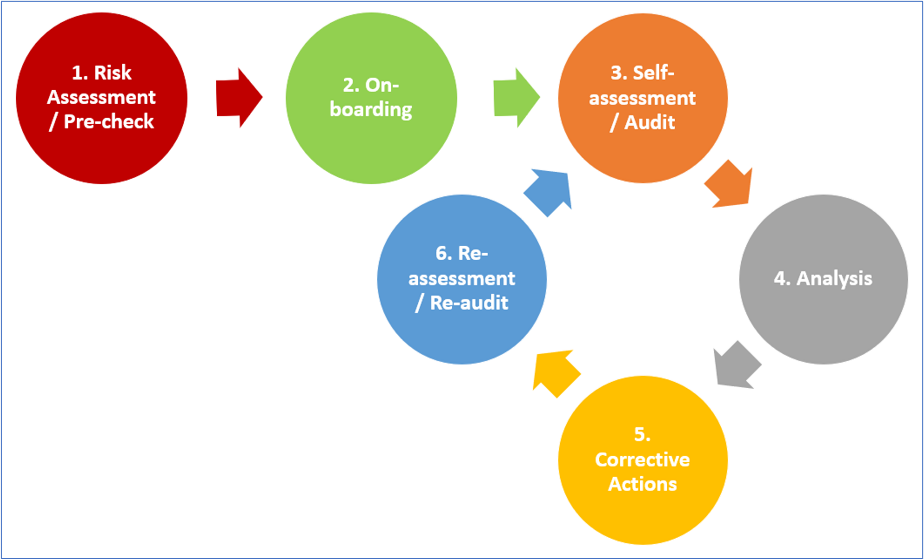
Responsible sourcing approach (continuation):
The process of sourcing commodities and goods precedes the start of any commercial relations with suppliers.
| 1.Risk assessment / Pre-check | |
 |
First of all, we assess the region / country of supply from sustainability point of view. This allows us to identify countries and markets that need increased attention and a special approach to environmental, social and governance aspects. |
| 2.Supplier On-boarding | |
 |
As per the results from the risk assessment and pre-check, we further establish the sourcing strategy. If the region or country is or has been known for significant environmental, social or ethical issues, then we refrain from initiation of any cooperation. If no significant risks have been found, the on-boarding process starts and suppliers are offered our Corporate Sustainable Sourcing Policy and Supplier Code of Conduct with our ESG commitments and expectations in the areas of human rights, employee standards, occupational health and safety, environment, anti-corruption, food safety and quality, which suppliers are required to acknowledge, sign and commit to. |
| 3.Self-assessment / Audit | |
 |
At the beginning of business cooperation, suppliers are required to disclose sustainability performance or to complete a self-assessment questionnaire with environmental, social and governance criteria. Depending on available resources and competences, part of suppliers will be audited to validate the disclosed information in self-assessment questionnaires or otherwise. Our audits consist of on-site visits by a company team composed of sustainability and acquisition functions to inspect the premises, equipment, processes and discuss with employees. |
| 4.Analysis | |
 |
A company dedicated team composed of sustainability and commercial functions will analyze the disclosed information by suppliers, the self-assessment questionnaires or audit reports to identify sustainability deficiencies and areas for improvement. Based on this analysis, suppliers will be included in the list of accepted suppliers and will be assigned different sustainability risk categories. Depending on sustainability risk category, suppliers will be approved, approved with conditions or, those who fail to comply to basic criteria, will be rejected. The failure to meet local legal requirements, the use of child or forced labor, involvement in deforestation or other activities with significant environmental or social impact are disqualifying criterial. |
| 5.Corrective Actions | |
 |
Based on deficiencies and areas for improvement identified, suppliers will be required to draw-up and commit corrective or improvement action plans. During the period of acceptance, the suppliers will be monitored related to the progress made vs. the agreed action plans until next assessment or audit. |
| 6.Re-assessment / Re-audits | |
 |
Re-assessment and re-audits will be planned based on supplier risk level assigned at the analysis stage of the process. Re-assessments and re-audits will be performed to monitor overall performance of suppliers, to follow- up on the agreed action plans and confirm continuous improvement. Repeated serious noncompliance are disqualifying conditions and will lead as well to termination of the commercial relationship. |
Supplier assessment/re-assessment, analysis and monitoring activities, is an on-going process, and the list of accepted suppliers is a dynamic one, new suppliers coming in and suppliers being excluded, in order to promote and improve sustainability in the supply chain.


